
Dentistry has entered a stage where treatment is no longer planned only from what can be seen clinically during an examination. Today, highly accurate digital systems allow clinicians to predict treatment outcomes before the first implant is placed or before orthodontic movement even begins. This has transformed both implantology and orthodontics, especially in cases where precision determines long-term success.
What makes digital planning so valuable is not simply the use of technology itself, but the ability to integrate diagnosis, treatment sequencing and final aesthetic goals into one coherent workflow.
For patients, this means fewer uncertainties, more predictable outcomes and a clearer understanding of what their treatment will involve from the very beginning.
In modern implant and orthodontic cases, planning digitally is no longer an optional enhancement; in many situations, it has become the safest and most effective way to achieve stable functional and aesthetic results.
At Condor Dent, digital treatment planning is now central to how complex dental cases are approached, allowing each stage to be designed with far greater accuracy than traditional methods allowed.
Why Digital Smile Design Has Changed Treatment Planning Completely
A smile is never isolated from the rest of the face. For that reason, modern planning begins by evaluating how teeth relate to facial proportions, lip movement and gingival exposure.
This is where digital smile design plays a crucial role.
Rather than planning restorations or orthodontic corrections only from dental models, clinicians now assess the smile dynamically through digital visualisation.
This process makes it possible to evaluate:
- tooth dimensions
- smile symmetry
- incisal display
- facial midline
- gingival balance
The purpose is not to create a standardised smile, but to design one that fits the patient’s facial identity.
This becomes especially important when implants or orthodontics affect visible anterior teeth.
A useful overview of how these technologies are reshaping treatment can be found here:
How 3D Implant Planning Reduces Surgical Margin for Error
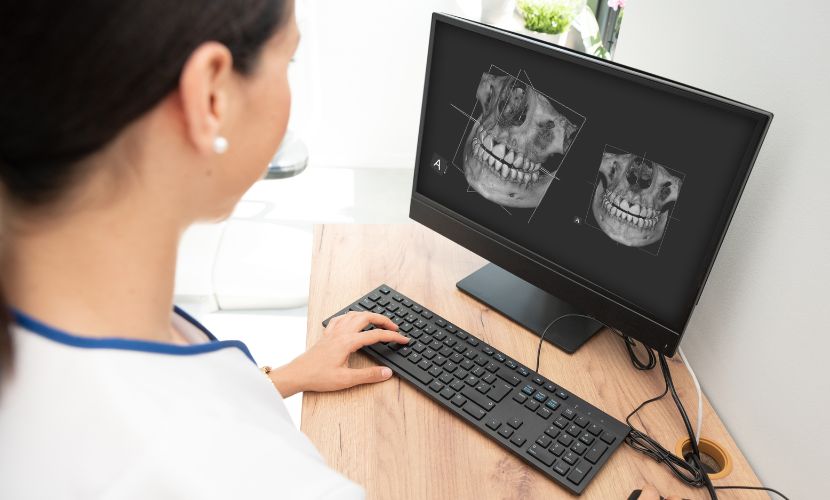
Implant treatment depends on far more than replacing a missing tooth.
Every implant must be positioned according to biological, prosthetic and mechanical principles.
This is why 3d implant planning has become fundamental in modern implantology.
Using digital imaging and volumetric radiographic analysis, clinicians can assess the exact anatomical conditions before surgery.
This includes:
- available bone height
- cortical thickness
- implant angulation
- nerve location
- sinus anatomy
What digital planning changes is that implant placement can now be designed from the final crown backwards.
In other words, the visible restorative outcome guides the implant position rather than adjusting later to surgical limitations.
This significantly improves long-term function and aesthetics.
Why Digital Planning Is Especially Important in Combined Cases
The greatest technical benefit appears when implants and orthodontics must interact.
A patient may require orthodontic movement before implant placement, or implants may need to be positioned according to future orthodontic alignment.
Without digital coordination, these treatments risk working against each other.
Digital systems allow clinicians to organise treatment in sequence:
- tooth movement first
- implant timing
- occlusal correction
- restorative integration
This integrated planning reduces unnecessary adjustments later.
It also improves communication between different treatment stages.
The Technical Value of Orthodontic Design in Complex Cases

Modern orthodontic design is based on controlled biomechanics rather than simple visual alignment.
The objective is not only to straighten teeth, but to guide movement according to functional balance.
Digital orthodontic planning allows simulation before treatment starts.
This means clinicians can analyse:
- root position
- arch coordination
- occlusal contacts
- bite stability
- final tooth inclination
This level of precision becomes particularly important when orthodontics is preparing space for implants or restorative rehabilitation.
Every movement must serve a broader objective.
Digital orthodontics reduces guesswork and improves predictability significantly.
Why Intraoral Digital Scanning Has Become Essential
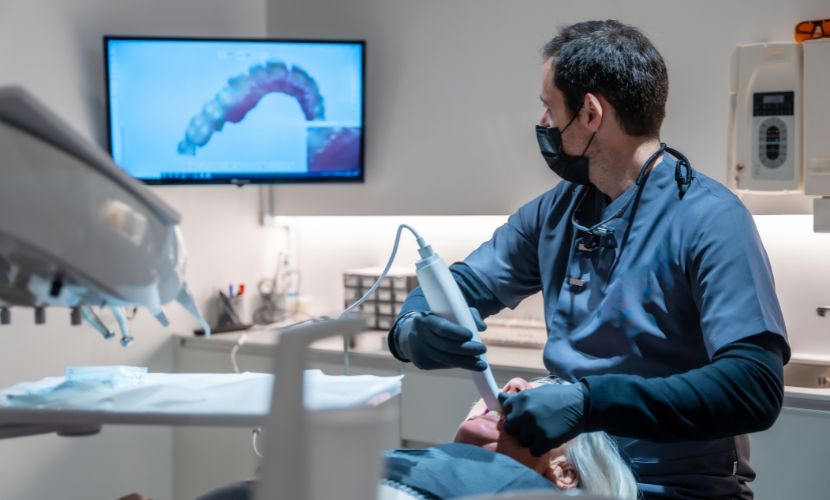
Traditional impressions often introduced limitations, especially in complex planning.
Digital scanning has removed many of these problems.
A modern intraoral scan produces highly detailed digital records immediately, allowing clinicians to work with precise three-dimensional models.
The main advantages include:
- improved patient comfort
- faster clinical workflow
- accurate digital storage
- immediate treatment integration
The scan can then be combined with radiographic data for complete digital planning.
For many patients, this also makes consultations much easier to understand because treatment becomes visually clear.
This process is explained here:
Why Predictability Matters More Than Treatment Speed
Patients often ask whether digital systems make treatment faster.
In reality, the greatest advantage is predictability.
A digitally planned treatment may still require time, but each phase becomes more controlled.
This reduces:
- surgical surprises
- prosthetic corrections
- mid-treatment adjustments
- avoidable complications
The goal is not speed alone, but reliability.
This is particularly valuable in implant cases where correcting mistakes later can be far more complex than preventing them early.
Learning from Real Clinical Outcomes
One of the strongest ways to understand digital planning is by looking at actual patient outcomes.
When digital planning is applied correctly, the difference is visible not only in the final smile but also in treatment stability.
A real clinical example can be seen here:
Cases like this show how digital preparation improves every phase of treatment rather than affecting only the surgical stage.
Why Booking at Condor Dent Is the Smart First Step
Digital planning only works properly when diagnosis is done carefully from the beginning.
A first consultation allows clinicians to determine:
- whether implants are needed
- whether orthodontics should come first
- how bone conditions affect treatment
- which digital tools are required
At Condor Dent, this early assessment allows treatment to be designed with long-term precision rather than short-term correction.
For many patients, this first step prevents years of delayed or incomplete treatment decisions.
Booking a consultation early often makes complex dental problems easier to solve than expected.

FAQs About Digital Implant and Orthodontic Planning
Is digital smile design only used for cosmetic dentistry?
No. It is also valuable in restorative and implant planning.
Does 3d implant planning improve implant longevity?
It improves placement precision, which strongly supports long-term stability.
Can orthodontic design be combined with implant treatment?
Yes, and digital planning makes this coordination far more precise.
Are digital scans more reliable than traditional impressions?
In many advanced cases, yes.
Is digital planning suitable for every patient?
Most complex restorative and orthodontic cases benefit significantly from it.
